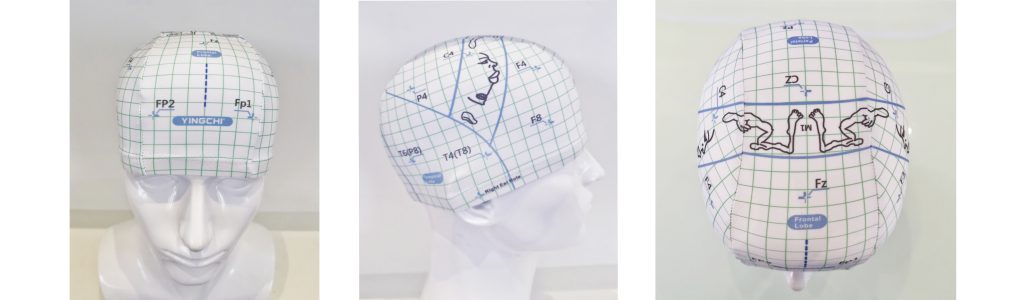
精準(zhǔn)定位是進(jìn)行閾值檢測(cè)和保證治療效果的重要基石。英智經(jīng)顱磁刺激儀(TMS)定位方法基于國(guó)際公認(rèn)的10-20腦電定位系統(tǒng),具有快速準(zhǔn)確找尋刺激靶點(diǎn)的優(yōu)勢(shì),適用于常規(guī)臨床的大樣本治療和腦區(qū)功能探究。
定位流程
1. 閾值測(cè)定后,依據(jù)安全篩查量表及患者病情,在英智經(jīng)顱磁刺激儀(TMS)系統(tǒng)軟件中選擇治療方案。
2. 根據(jù)治療方案,確定目標(biāo)靶區(qū)與定位帽刺激靶點(diǎn)(見(jiàn)下圖)。
3. 移動(dòng)線圈使磁場(chǎng)輸出中心與刺激靶點(diǎn)重合,線圈須與頭皮相切,保證磁場(chǎng)接收最大化。
4. 調(diào)整好位置后,將線圈固定,按照所選方案的參數(shù)開始治療。
注意事項(xiàng)
1. 治療過(guò)程中,應(yīng)主動(dòng)詢問(wèn)患者感受及耐受度以決定是否需要調(diào)整刺激強(qiáng)度。如需調(diào)整,以1%的幅度調(diào)整刺激強(qiáng)度。
2. 治療期間,應(yīng)要求患者保持姿勢(shì)不變,避免刺激脫靶。
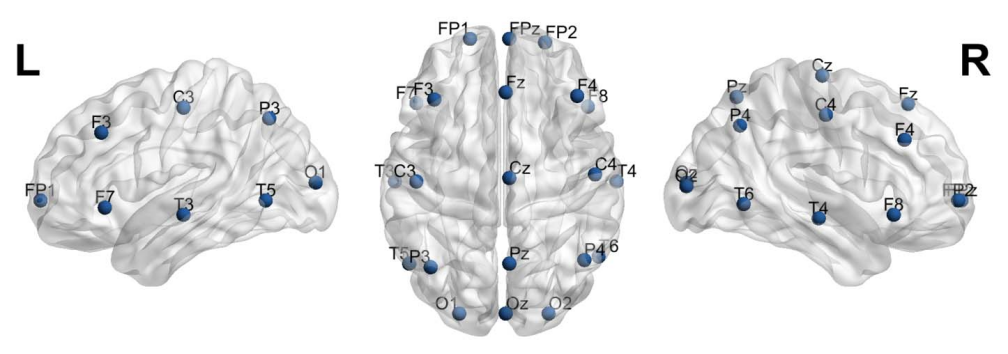
基于國(guó)際10-20系統(tǒng)的TMS刺激靶點(diǎn)及適應(yīng)癥[1]
腦區(qū)名稱 | 電極位點(diǎn) | Brodmann分區(qū)[1,29] | TMS適應(yīng)癥[30] | |
左半球 | 右半球 | |||
眶額葉皮質(zhì) (Orbitofrontal cortex,OFC) | Fp1[2] | Fp2[3] | 10區(qū) | 抑郁癥[31];強(qiáng)迫癥[32];中風(fēng)后意識(shí)障礙[33]等 |
背外側(cè)前額葉 (Dorsolateral prefrontal cortex,DLPFC) | F3[4] | F4[5] | 46區(qū) | 抑郁癥[34];焦慮抑郁癥[35];帕金森抑郁[36];纖維肌痛[37];物質(zhì)成癮[38];精神分裂癥陰性癥狀[39];意識(shí)障礙[40];失眠[41];創(chuàng)傷后應(yīng)激障礙[42];強(qiáng)迫癥[43]等 |
前額下回 (Inferior frontal gyrus,IFG) | F7[6] | F8[7] | 45,46區(qū) | 卒中后失語(yǔ)癥[44];兒童注意力缺陷障礙(語(yǔ)言發(fā)育遲緩)[45]等 |
初級(jí)運(yùn)動(dòng)皮層-手部熱點(diǎn) (Hand hotspots in primary motor cortex,HH-M1) | C3[8] | C4[9] | 4區(qū) | 腦卒中運(yùn)動(dòng)障礙[46];神經(jīng)性疼痛[47];帕金森運(yùn)動(dòng)障礙[48];意識(shí)障礙[49];纖維肌痛[50];肌張力異常[51];多發(fā)性硬化[52]等 |
顳中上回 (Superior middle temporal gyrus,SMTG) | T3[10] | T4[11] | 21,22區(qū) | 耳鳴[53],幻聽[54]等 |
頂枕交界處角回 (Angular gyrus of parietal occipital junction,AG-POJ) | P3[12] | P4[13] | 7區(qū) | 卒中后偏側(cè)忽視[55];冰毒成癮[56]等 |
緣上回 (Superior marginal gyrus,SMG) | TP3[14] | TP4[15] | 39,40區(qū) | 精神分裂幻聽癥狀[57];耐藥性幻聽[58];抑郁癥幻聽[59] |
后顳葉海馬旁回 (Parahippocampal gyrus of posterior temporal lobe,PHG-PTL) | T5[16] | T6[17] | 37,19,37,39區(qū) | 阿爾茨海默病輕度認(rèn)知障礙[60];耳鳴[61]等 |
輔助運(yùn)動(dòng)區(qū) (Supplementary Motor Cortex,SMA) | Fz[18] | 6區(qū) | 帕金森病運(yùn)動(dòng)障礙[62];震顫[63];肌張力異常[64];不寧腿綜合征[65];抽動(dòng)穢語(yǔ)綜合癥[66];強(qiáng)迫癥[67]等 | |
枕葉 (Occipital lobe) | O1[19] | O2[20] | 17區(qū) | 卒中后吞咽障礙[68];慢性腦卒中肢體功能障礙[69];帕金森病共濟(jì)失調(diào)[70]等 |
顳頂聯(lián)合區(qū) (Temporoparietal junction,TPJ) | T3-P3連線的中點(diǎn)[21] | T4-P4連線的中點(diǎn)[22] | 41,42區(qū) | 慢性耳鳴[71];精神分裂癥幻聽[72]等 |
布洛卡區(qū) (Broca's area) | T3-Fz連線與F7-Cz連線的交叉點(diǎn)[23] | T4-Fz連線與F8-Cz連線的交叉點(diǎn)[24] | 44,45區(qū) | 失語(yǔ)癥[73];卒中后失語(yǔ)[74];阿爾茨海默病語(yǔ)言認(rèn)知異常[75];精神分裂幻聽[76]等 |
韋尼克區(qū) (Wernicke’s area) | C3-T5連線與T3-P3連線的交叉點(diǎn)[25] | C4-T6連線與P4-T4連線的交叉點(diǎn)[26] | 22區(qū) | 阿爾茨海默病(語(yǔ)言理解異常)[75];卒中后失語(yǔ)[77]等 |
初級(jí)運(yùn)動(dòng)皮層吞咽功能 (Swallowing functional area of primary motor cortex,SFA-M1) | C3-T3連線的中點(diǎn)[27] | C4-T4連線的中點(diǎn)[28] | 4區(qū) | 卒中后吞咽障礙[78];帕金森吞咽困難[79]等 |
參考文獻(xiàn)
1.Homan R W. The 10-20 electrode system and cerebral location[J]. American Journal of EEG Technology, 1988, 28(4): 269-279.
2.Green P E, Loftus A, Anderson R A. Protocol for transcranial direct current stimulation for obsessive-compulsive disorder[J]. Brain Sciences, 2020, 10(12): 1008.
3.Nejati V, Salehinejad M A, Nitsche M A, et al. Transcranial direct current stimulation improves executive dysfunctions in ADHD: implications for inhibitory control, interference control, working memory, and cognitive flexibility[J]. Journal of attention disorders, 2020, 24(13): 1928-1943.
4.Nejati V, Salehinejad M A, Nitsche M A. Interaction of the left dorsolateral prefrontal cortex (l-DLPFC) and right orbitofrontal cortex (OFC) in hot and cold executive functions: Evidence from transcranial direct current stimulation (tDCS)[J]. Neuroscience, 2018, 369: 109-123.
5.Dubreuil-Vall L, Chau P, Ruffini G, et al. tDCS to the left DLPFC modulates cognitive and physiological correlates of executive function in a state-dependent manner[J]. Brain Stimulation, 2019, 12(6): 1456-1463.
6.Hara T, Abo M, Kakita K, et al. The effect of selective transcranial magnetic stimulation with functional near-infrared spectroscopy and intensive speech therapy on individuals with post-stroke aphasia[J]. European Neurology, 2017, 77(3-4): 186-194.
7.Huang Y, Zhang B, Cao J, et al. Potential locations for noninvasive brain stimulation in treating autism spectrum disorders—a functional connectivity study[J]. Frontiers in psychiatry, 2020, 11: 388.
8.Pfurtscheller G, Neuper C, Andrew C, et al. Foot and hand area mu rhythms[J]. International Journal of Psychophysiology, 1997, 26(1-3): 121-135.
9.Hu S, Wang H, Zhang J, et al. Causality from Cz to C3/C4 or between C3 and C4 revealed by Granger causality and new causality during motor imagery[C]//2014 International Joint Conference on Neural Networks (IJCNN). IEEE, 2014: 3178-3185.
10.Steed M, Bigler E D. MRI Brain Atlas[M]//Neuroimaging I. Springer, Boston, MA, 1996: 215-334.
11.Zhang Y, Hauser U, Conty C, et al. Familial risk for depression and p3b component as a possible neurocognitive vulnerability marker[J]. Neuropsychobiology, 2007, 55(1): 14-20.
12.Spitoni G F, Pireddu G, Cimmino R L, et al. Right but not left angular gyrus modulates the metric component of the mental body representation: a tDCS study[J]. Experimental brain research, 2013, 228(1): 63-72.
13.Pick H, Lavidor M. Modulation of automatic and creative features of the Remote Associates Test by angular gyrus stimulation[J]. Neuropsychologia, 2019, 129: 348-356.
14.Xie Y, He Y, Guan M, et al. Impact of low-frequency rTMS on functional connectivity of the dentate nucleus subdomains in schizophrenia patients with auditory verbal hallucination[J]. Journal of Psychiatric Research, 2022, 149: 87-96.
15.Vines B W, Schnider N M, Schlaug G. Testing for causality with transcranial direct current stimulation: pitch memory and the left supramarginal gyrus[J]. Neuroreport, 2006, 17(10): 1047.
16.Sindou M, Guenot M. Surgical anatomy of the temporal lobe for epilepsy surgery[J]. Advances and technical standards in neurosurgery, 2003: 315-343.
17.Velasco A L, Velasco M, Velasco F, et al. Subacute and chronic electrical stimulation of the hippocampus on intractable temporal lobe seizures: preliminary report[J]. Archives of Medical Research, 2000, 31(3): 316-328.
18.Weersink J B, Maurits N M, de Jong B M. EEG time-frequency analysis provides arguments for arm swing support in human gait control[J]. Gait & posture, 2019, 70: 71-78.
19.Sahota P. Occipital Lobes (O1 and O2): Visualizing the World through Recognition and Patterns[M]//Practical Neurocounseling. Routledge, 2020: 171-176.
20.Wang C P, Hsieh P F, Chen C C C, et al. Hyperglycemia with occipital seizures: images and visual evoked potentials[J]. Epilepsia, 2005, 46(7): 1140-1144.
21.Watson N, Jabbour S, Sadler S, et al. Is there an optimal rTMS target to treat chronic tinnitus?[J]. Brain Stimulation: Basic, Translational, and Clinical Research in Neuromodulation, 2021, 14(6): 1689-1690.
22.Mantovani A, Simeon D, Urban N, et al. Temporo-parietal junction stimulation in the treatment of depersonalization disorder[J]. Psychiatry research, 2011, 186(1): 138-140.
23.Monti A, Cogiamanian F, Marceglia S, et al. Improved naming after transcranial direct current stimulation in aphasia[J]. Journal of Neurology, Neurosurgery & Psychiatry, 2008, 79(4): 451-453.
24.Friederici A D, Hahne A, Von Cramon D Y. First-pass versus second-pass parsing processes in a Wernicke's and a Broca's aphasic: electrophysiological evidence for a double dissociation[J]. Brain and language, 1998, 62(3): 311-341.
25.Friederici A D, Hahne A, Von Cramon D Y. First-pass versus second-pass parsing processes in a Wernicke's and a Broca's aphasic: electrophysiological evidence for a double dissociation[J]. Brain and language, 1998, 62(3): 311-341.
26.Marchina S, Schlaug G, Kumar S. Study design for the fostering eating after stroke with transcranial direct current stimulation trial: A randomized controlled intervention for improving dysphagia after acute ischemic stroke[J]. Journal of Stroke and Cerebrovascular Diseases, 2015, 24(3): 511-520.
27.Imperatori C, Fabbricatore M, Innamorati M, et al. Modification of EEG functional connectivity and EEG power spectra in overweight and obese patients with food addiction: An eLORETA study[J]. Brain imaging and behavior, 2015, 9(4): 703-716.
28.Scherer L C, Fonseca R P, Amiri M, et al. Syntactic processing in bilinguals: an fNIRS study[J]. Brain and language, 2012, 121(2): 144-151.
29.Ward J. The student's guide to cognitive neuroscience[M]. psychology press, 2015.
30.Lefaucheur J P, Aleman A, Baeken C, et al. Evidence-based guidelines on the therapeutic use of repetitive transcranial magnetic stimulation (rTMS): an update (2014–2018)[J]. Clinical neurophysiology, 2020, 131(2): 474-528.
31.Schutter D J L G, van Honk J. Increased positive emotional memory after repetitive transcranial magnetic stimulation over the orbitofrontal cortex[J]. Journal of Psychiatry and Neuroscience, 2006, 31(2): 101-104.
32.Ruffini C, Locatelli M, Lucca A, et al. Augmentation effect of repetitive transcranial magnetic stimulation over the orbitofrontal cortex in drug-resistant obsessive-compulsive disorder patients: a controlled investigation[J]. The Primary Care Companion for CNS Disorders, 2009, 11(5): 23968.
33.Bai Y, Xia X, Kang J, et al. Evaluating the effect of repetitive transcranial magnetic stimulation on disorders of consciousness by using TMS-EEG[J]. Frontiers in neuroscience, 2016, 10: 473.
34.Fitzgerald P B, Daskalakis Z J. A practical guide to the use of repetitive transcranial magnetic stimulation in the treatment of depression[J]. Brain Stimulation, 2012, 5(3): 287-296.
35.Du L, Liu H, Du W, et al. Stimulated left DLPFC-nucleus accumbens functional connectivity predicts the anti-depression and anti-anxiety effects of rTMS for depression[J]. Translational psychiatry, 2018, 7(11): 1-10.
36.Randver R. Repetitive transcranial magnetic stimulation of the dorsolateral prefrontal cortex to alleviate depression and cognitive impairment associated with Parkinson's disease: A review and clinical implications[J]. Journal of the Neurological Sciences, 2018, 393: 88-99.
37.Tanwar S, Mattoo B, Kumar U, et al. Repetitive transcranial magnetic stimulation of the prefrontal cortex for fibromyalgia syndrome: a randomised controlled trial with 6-months follow up[J]. Advances in Rheumatology, 2020, 60.
38.Enokibara M, Trevizol A, Shiozawa P, et al. Establishing an effective TMS protocol for craving in substance addiction: Is it possible?[J]. The American journal on addictions, 2016, 25(1): 28-30.
39.Prikryl R, Ustohal L, Kucerova H P, et al. Repetitive transcranial magnetic stimulation reduces cigarette consumption in schizophrenia patients[J]. Progress in Neuro-Psychopharmacology and Biological Psychiatry, 2014, 49: 30-35.
40.Naro A, Russo M, Leo A, et al. A single session of repetitive transcranial magnetic stimulation over the dorsolateral prefrontal cortex in patients with unresponsive wakefulness syndrome: preliminary results[J]. Neurorehabilitation and Neural Repair, 2015, 29(7): 603-613.
41.Jiang C, Zhang T, Yue F, et al. Efficacy of repetitive transcranial magnetic stimulation in the treatment of patients with chronic primary insomnia[J]. Cell biochemistry and biophysics, 2013, 67(1): 169-173.
42.Ahmadizadeh M J, Rezaei M. Unilateral right and bilateral dorsolateral prefrontal cortex transcranial magnetic stimulation in treatment post-traumatic stress disorder: A randomized controlled study[J]. Brain research bulletin, 2018, 140: 334-340.
43.Elbeh K A M, Elserogy Y M B, Khalifa H E, et al. Repetitive transcranial magnetic stimulation in the treatment of obsessive-compulsive disorders: Double blind randomized clinical trial[J]. Psychiatry Research, 2016, 238: 264-269.
44.Hara T, Abo M, Kobayashi K, et al. Effects of low-frequency repetitive transcranial magnetic stimulation combined with intensive speech therapy on cerebral blood flow in post-stroke aphasia[J]. Translational stroke research, 2015, 6(5): 365-374.
45.Qiu A, Li X, Yang Z, Li Z, Wang J, Yuan H, et al. The effects of combined application oftranscranial magnetic stimulation and language training on children withlanguage retardation. Minerva Pediatr. 2016 Oct 28. [Epub ahead of print].
46.Trompetto C, Assini A, Buccolieri A, et al. Motor recovery following stroke: a transcranial magnetic stimulation study[J]. Clinical Neurophysiology, 2000, 111(10): 1860-1867.
47.Knotkova H, Cruciani R A. Non-invasive transcranial direct current stimulation for the study and treatment of neuropathic pain[M]//Analgesia. Humana Press, Totowa, NJ, 2010: 505-515.
48.LEE D H, PARK K W, PARK M K, et al. Transcranial magnetic stimulation in Parkinson's disease[J]. Journal of the Korean Neurological Association, 1999: 352-358.
49.Xie Y, Zhang T. Repetitive transcranial magnetic stimulation improves consciousness disturbance in stroke patients: A quantitative electroencephalography spectral power analysis[J]. Neural Regeneration Research, 2012, 7(31): 2465.
50.Khedr E M, Omran E A H, Ismail N M, et al. Effects of transcranial direct current stimulation on pain, mood and serum endorphin level in the treatment of fibromyalgia: A double blinded, randomized clinical trial[J]. Brain stimulation, 2017, 10(5): 893-901.
51.Siebner H R, Filipovic S R, Rowe J B, et al. Patients with focal arm dystonia have increased sensitivity to slow‐frequency repetitive TMS of the dorsal premotor cortex[J]. Brain, 2003, 126(12): 2710-2725.
52.Mori F, Codecà C, Kusayanagi H, et al. Effects of anodal transcranial direct current stimulation on chronic neuropathic pain in patients with multiple sclerosis[J]. The journal of pain, 2010, 11(5): 436-442.
53.Folmer R L, Carroll J R, Rahim A, et al. Effects of repetitive transcranial magnetic stimulation (rTMS) on chronic tinnitus[J]. Acta Oto-Laryngologica, 2006, 126(sup556): 96-101.
54.Chibbaro G, Daniele M, Alagona G, et al. Repetitive transcranial magnetic stimulation in schizophrenic patients reporting auditory hallucinations[J]. Neuroscience letters, 2005, 383(1-2): 54-57.
55.Kim B R, Chun M H, Kim D Y, et al. Effect of high-and low-frequency repetitive transcranial magnetic stimulation on visuospatial neglect in patients with acute stroke: a double-blind, sham-controlled trial[J]. Archives of physical medicine and rehabilitation, 2013, 94(5): 803-807.
56.Liu Q, Shen Y, Cao X, et al. Either at left or right, both high and low frequency rTMS of dorsolateral prefrontal cortex decreases cue induced craving for methamphetamine[J]. The American journal on addictions, 2017, 26(8): 776-779.
57.JUNG K H, CHOI C S, PARK J S, et al. Effects of repetitive transcranial magnetic stimulation to temporoparietal cortex in patients with chronic schizophrenia with treatment-resistant auditory hallucinations[J]. Journal of Korean Neuropsychiatric Association, 2004: 546-551.
58.Hoffman R E, Hawkins K A, Gueorguieva R, et al. Transcranial magnetic stimulation of left temporoparietal cortex and medication-resistant auditory hallucinations[J]. Archives of general psychiatry, 2003, 60(1): 49-56.
59.Freitas C., Pearlman C., Pascual-Leone, A., 2012. Treatment of auditory verbal hallucinations with transcranial magnetic stimulation in a patient with psychotic major depression: one-year follow-up. Neurocase 18 (1), 57–65.
60.Chang C H, Lane H Y, Lin C H. Brain stimulation in Alzheimer's disease[J]. Frontiers in Psychiatry, 2018, 9: 201.
61.Plewnia C, Bartels M, Gerloff C. Transient suppression of tinnitus by transcranial magnetic stimulation[J]. Annals of Neurology: Official Journal of the American Neurological Association and the Child Neurology Society, 2003, 53(2): 263-266.
62.Boylan L S, Pullman S L, Lisanby S H, et al. Repetitive transcranial magnetic stimulation to SMA worsens complex movements in Parkinson's disease[J]. Clinical Neurophysiology, 2001, 112(2): 259-264.
63.Lu M K, Chiou S M, Ziemann U, et al. Resetting tremor by single and paired transcranial magnetic stimulation in Parkinson’s disease and essential tremor[J]. Clinical Neurophysiology, 2015, 126(12): 2330-2336.
64.Siebner H R, Filipovic S R, Rowe J B, et al. Patients with focal arm dystonia have increased sensitivity to slow‐frequency repetitive TMS of the dorsal premotor cortex[J]. Brain, 2003, 126(12): 2710-2725.
65.Altunrende B, Yildiz S, Cevik A, et al. Repetitive transcranial magnetic stimulation in restless legs syndrome: preliminary results[J]. Neurological Sciences, 2014, 35(7): 1083-1088.
66.Kahl C K, Kirton A, Pringsheim T, et al. Bilateral transcranial magnetic stimulation of the supplementary motor area in children with Tourette syndrome[J]. Developmental Medicine & Child Neurology, 2021, 63(7): 808-815.
67.Mantovani A, Simpson H B, Fallon B A, et al. Randomized sham-controlled trial of repetitive transcranial magnetic stimulation in treatment-resistant obsessive–compulsive disorder[J]. The The International Journal of Neuropsychopharmacology, 2010, 13(2): 217-227.
68.Vasant D H, Sasegbon A, Michou E, et al. Rapid improvement in brain and swallowing behavior induced by cerebellar repetitive transcranial magnetic stimulation in poststroke dysphagia: A single patient case‐controlled study[J]. Neurogastroenterology & Motility, 2019, 31(7): e13609.
69.Liao L Y, Xie Y J, Chen Y, et al. Cerebellar theta-burst stimulation combined with physiotherapy in subacute and chronic stroke patients: a pilot randomized controlled trial[J]. Neurorehabilitation and Neural Repair, 2021, 35(1): 23-32.
70.Carrillo F, Palomar F J, Conde V, et al. Study of cerebello-thalamocortical pathway by transcranial magnetic stimulation in Parkinson's disease[J]. Brain stimulation, 2013, 6(4): 582-589.
71.Schoisswohl S, Langguth B, Hebel T, et al. Personalization of Repetitive Transcranial Magnetic Stimulation for the Treatment of Chronic Subjective Tinnitus[J]. Brain Sciences, 2022, 12(2): 203.
72.Vercammen A, Knegtering H, Liemburg E J, et al. Functional connectivity of the temporo-parietal region in schizophrenia: effects of rTMS treatment of auditory hallucinations[J]. Journal of psychiatric research, 2010, 44(11): 725-731.
73.Naeser M A, Martin P I, Nicholas M, et al. Improved picture naming in chronic aphasia after TMS to part of right Broca’s area: an open-protocol study[J]. Brain and language, 2005, 93(1): 95-105.
74.Szaflarski J P, Vannest J, Wu S W, et al. Excitatory repetitive transcranial magnetic stimulation induces improvements in chronic post-stroke aphasia[J]. Medical science monitor: international medical journal of experimental and clinical research, 2011, 17(3): CR132.
75.Sabbagh M, Sadowsky C, Tousi B, et al. Effects of a combined transcranial magnetic stimulation (TMS) and cognitive training intervention in patients with Alzheimer's disease[J]. Alzheimer's & Dementia, 2019.
76.Kim E J, Yeo S, Hwang I, et al. Bilateral repetitive transcranial magnetic stimulation for auditory hallucinations in patients with schizophrenia: a randomized controlled, cross-over study[J]. Clinical Psychopharmacology and Neuroscience, 2014, 12(3): 222.
77.Versace V, Schwenker K, Langthaler P B, et al. Facilitation of Auditory Comprehension After Theta Burst Stimulation of Wernicke's Area in Stroke Patients: A Pilot Study[J]. Frontiers in Neurology, 2020, 10: 1319.
78.Khedr E M, Abo‐Elfetoh N, Rothwell J C. Treatment of post‐stroke dysphagia with repetitive transcranial magnetic stimulation[J]. Acta Neurologica Scandinavica, 2009, 119(3): 155-161.
79.Khedr E M, Mohamed K O, Soliman R K, et al. The effect of high-frequency repetitive transcranial magnetic stimulation on advancing Parkinson’s disease with dysphagia: double blind randomized clinical trial[J]. Neurorehabilitation and neural repair, 2019, 33(6): 442-452.
英智科技


在線溝通,請(qǐng)點(diǎn)我在線咨詢
咨詢熱線:
0755-21611741
客服qq:
2083990141